Multi-site operations messaging

You sent it to every site.
Did every site read it?

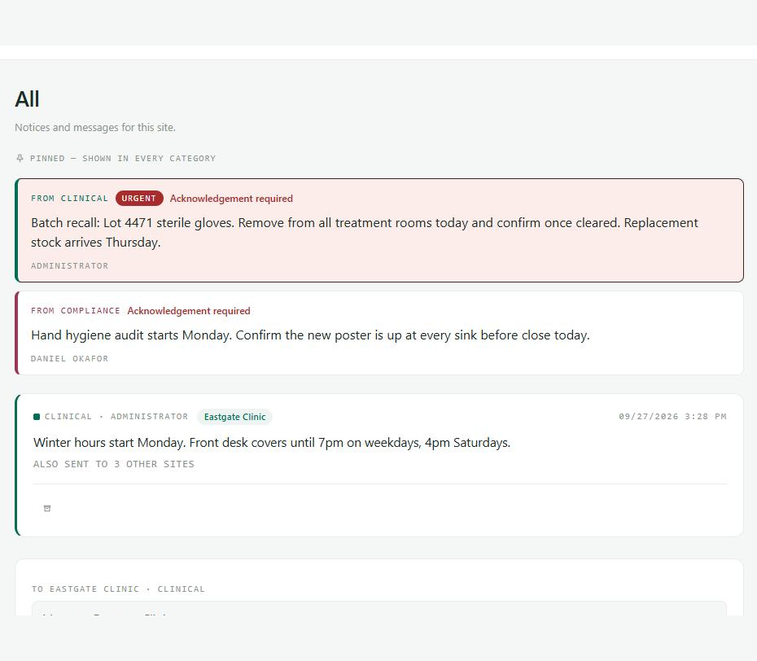
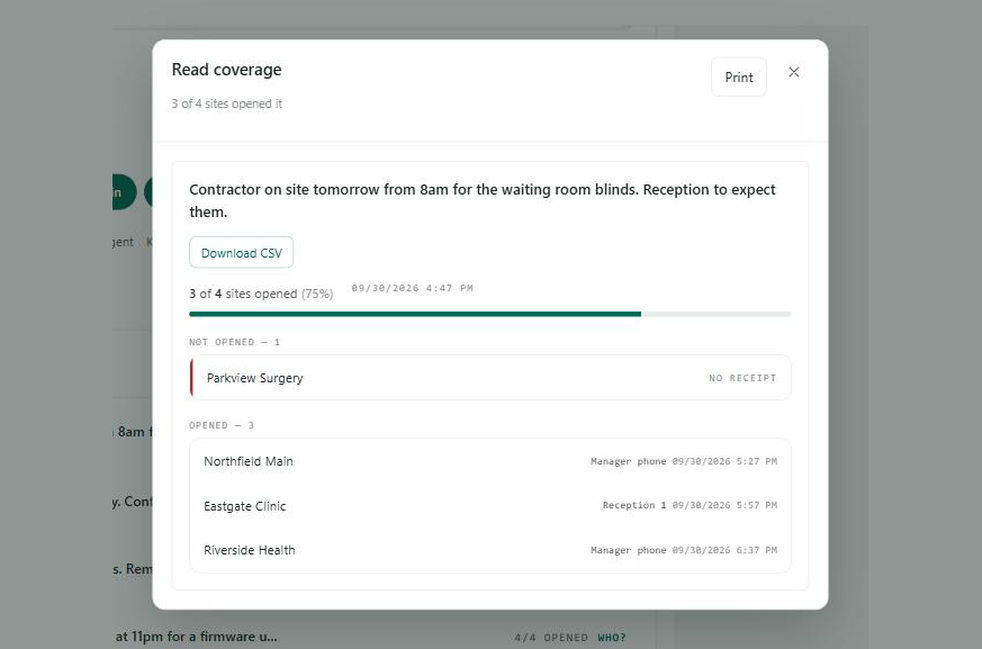
Kestrelay names the locations that opened your notice, the person who acknowledged it, and the branches still outstanding at four o'clock. A group chat cannot do any of that.

The gap

Every question a group chat answers with a shrug

Head office already has messaging. What it does not have is a record of what reached which location, and who took responsibility for it.

  • Did site 12 see the recall notice?
  • Who signed off on the safety brief?
  • What happened to the broken card reader?
  • A manager left on Friday. Now what?
See how it answers them
How it works

Four decisions that make the record trustworthy

Each one exists because the obvious alternative quietly produces a report nobody should believe.

01

The screen is already on

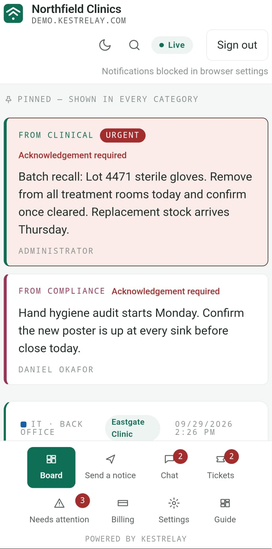
A small Windows app sits in the tray of every counter PC, badged with the number of items waiting. Nothing to log into, nothing to open in the morning.

02

Read has to mean read

An always-visible screen would mark everything read the instant it rendered. Opening is a deliberate act here, so the report means something.

03

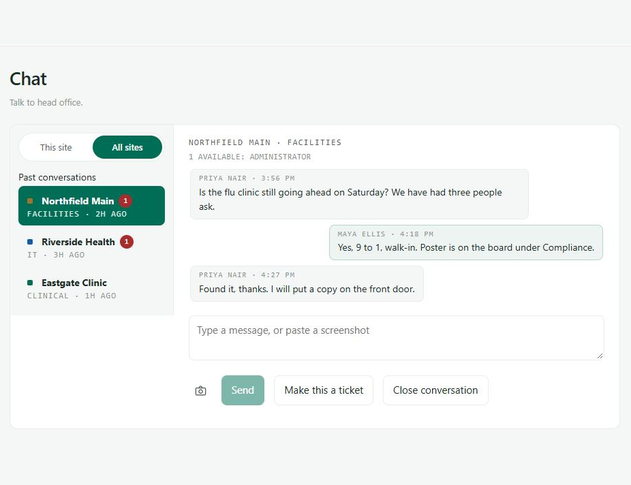
Sites can answer back

Broadcast-only systems die within a month. Staff raise a request at the counter, attach a photo from any phone, then watch its status change.

04

A name without a queue

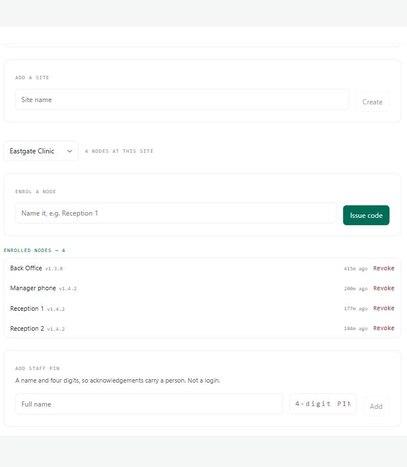
The terminal signs in, not the person. Notices that need accountability ask for a four digit staff PIN, so you get a real name where it matters.
Pricing

Priced by nodes, not by messages

A node is anything that signs in: a counter PC, a manager's phone, a supervisor at head office. Staff PINs are unlimited and free, so a site can name everyone who acknowledges a notice without paying for them.

Billed monthly or yearly. Setup, training and the first site rollout are included.
Industries

Built for any business with more than one address

Dealership groups Dental practices Veterinary groups Gyms and studios Restaurant groups Pharmacy chains Convenience retail Franchise networks
Upward

Requests that do not vanish

Internal request systems die because staff file something, hear nothing, decide it is a black hole and go back to phoning the supervisor. So the site sees the status the whole way through.

  • Filed at the counter, routed by category
  • Photo attached by scanning a code with any phone
  • Open, in progress, resolved, visible to the site
See the request flow
Questions

What operators ask first

A group chat cannot tell you which locations read a message. Kestrelay records delivery, opening and named acknowledgement as three separate events, and reports which sites have not opened a notice. It also isolates sites from each other, which a group cannot do.

No. The counter PC itself is enrolled as the authenticated device, so there is no login queue at a shared terminal. Notices that need accountability ask for a four digit staff PIN, which produces a named acknowledgement without creating user accounts.

Yes. Kestrelay is offline first. The board keeps working without a connection, messages queue locally, and the client shows its connection state so staff know what has sent.

It installs to the home screen on iOS and Android with push notifications, so there is no App Store download to manage across locations. Supervisors use their own account login on their phones.

There is no cross-site messaging and no shared attachment pool. Each client also runs on its own database rather than a shared table, with row level security inside it as a second layer.

Two or three sites for a fortnight first, then the rest inside a week. Each location gets its own setup sheet with enrolment codes, and installs run a few minutes per PC.

Twenty minutes, your own sites on the screen

We seed an instance with your locations and the categories you would actually use, send one notice, and watch the coverage fill in. No slides. If it does not answer a question you have, we will say so.